Lesson 1 of 104:104 Sources
Currency pairs: majors, minors and exotics
Recorded. Publishing soon
Educational content, not investment advice. Nour explains how markets work. She never tells you what to buy or sell.
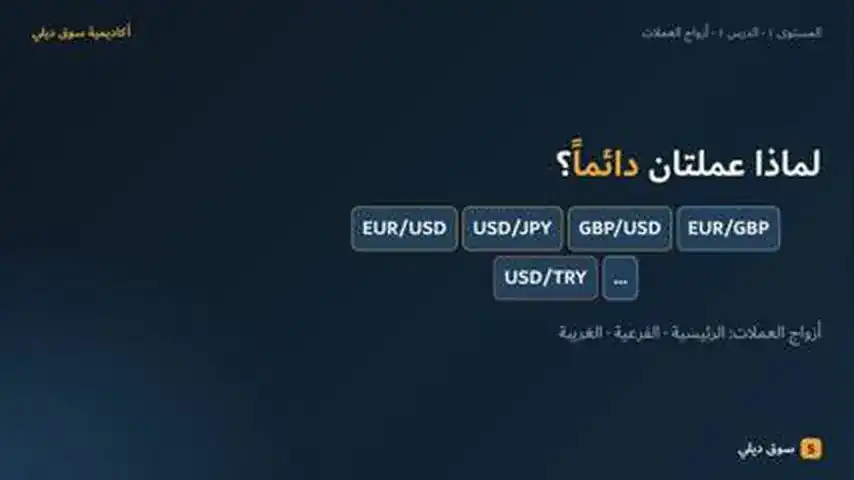
In forex you always buy one currency and sell another at the same time, so currencies are quoted in pairs.
- The first currency is the base, the second is the quote: EUR/USD at 1.1000 means 1 euro = 1.10 dollars.
- Majors pair the US dollar with another major currency; the dollar was on one side of about 89% of trades in April 2025 (BIS).
- Minors (crosses) pair major currencies without the dollar; spreads are usually a little wider.
- Exotics involve smaller or emerging-market currencies: lower volume, wider spreads, sharper jumps.
- Five trades that all buy the dollar are really one bet.
Quick check
Three questions. Pick an answer to see why.
1.In EUR/USD = 1.1000, what does the price tell you?
2.Which of these is a minor (cross) pair?
3.You sell EUR/USD, sell GBP/USD and buy USD/JPY. What is the real risk?
Sources
Every fact in this lesson is backed by the sources below.
- 1.BIS Triennial Central Bank Survey 2025 — OTC FX turnoverDaily FX turnover ≈ $9.6 trillion (April 2025); US dollar on one side of 89.2% of trades
- 2.BIS Triennial Survey 2025 — FX statistical annex (turnover by currency pair)EUR/USD has the largest spot turnover of any pair (April 2025)
- 3.BIS Working Paper 1094 — The Foreign Exchange Market (Chaboud, Rime, Sushko, 2023)Exchange rates are quoted as currency pairs with the base currency listed first
- 4.CME Group Education — Micro FX futures: understanding the FX marketFirst currency = base currency, second = quote (terms) currency
Educational content, not investment advice. Risk warning: trading forex, CFDs, gold and crypto carries a high level of risk and may not be suitable for everyone. You can lose more than you put in. Souq Daily is an education platform. Nothing here is investment advice, a recommendation or an offer, and past performance does not predict future results.