Lesson 4 of 123:582 Sources
Support and resistance
Recorded. Publishing soon
Educational content, not investment advice. Nour explains how markets work. She never tells you what to buy or sell.
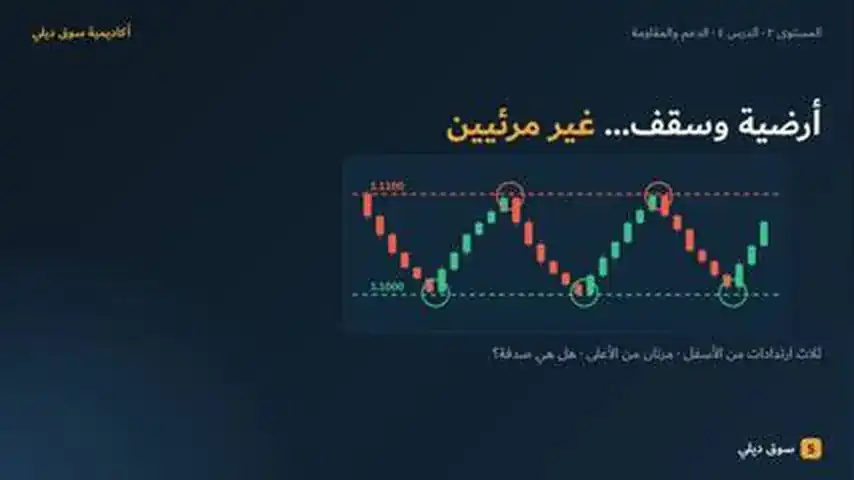
Support and resistance are levels where price is more likely to stop or change direction.
- Support is a floor where buyers tend to appear; resistance is a ceiling where sellers tend to appear.
- Draw them by connecting the lows (support) or the highs (resistance).
- They form because traders act similarly at familiar prices, including round numbers.
- When broken, support can become resistance and vice versa; rising volume on the break is seen as extra confirmation.
- They are zones, not exact lines: place stops beyond the whole zone, and accept that any level can break.
Quick check
Three questions. Pick an answer to see why.
1.What usually happens to a broken resistance level?
2.How should you think about support and resistance?
3.Where does a professional usually place the stop loss when buying at support?
Sources
Every fact in this lesson is backed by the sources below.
- 1.CME Group Education — Support and resistanceDefinition; role reversal; traders act similarly at certain prices; levels are zones that do not always hold exactly
- 2.ASX — Shares course 11: Technical analysis (PDF)Drawing resistance through highs and support through lows; rising volume on a break regarded as further confirmation
Educational content, not investment advice. Risk warning: trading forex, CFDs, gold and crypto carries a high level of risk and may not be suitable for everyone. You can lose more than you put in. Souq Daily is an education platform. Nothing here is investment advice, a recommendation or an offer, and past performance does not predict future results.